Scaling live event operations requires ditching spreadsheets and fragmented systems for centralized venue management workflows.
-
Traditional methods create communication gaps, double-bookings, and settlement nightmares that compound as show volume increases.
-
Successful venues and promoters integrate hold management, financial tracking, and team communication into unified systems.
-
Live event management tools that sync with ticketing platforms eliminate manual reconciliation and reduce errors.
If your current workflow requires more than two platforms to book and settle a show, you're leaving money and time on the table.
Running a single show is manageable chaos. Running 200+ shows per year across multiple rooms while coordinating with dozens of agents, promoters, and vendors? That's where most venue operations start hemorrhaging time and money.
The concert business continues reaching new heights, with the top 100 global tours generating a combined $9.1 billion in ticket sales. But increased volume has exposed a painful truth: the patchwork systems that worked for 50 shows a year completely collapse at scale. Professionals who haven't modernized their venue management workflows are watching competitors book faster, settle cleaner, and build better relationships with talent buyers.
Why Do Traditional Venue Event Operations Break Down?
The typical indie venue or regional promoter still operates on a foundation of spreadsheets, email threads, and institutional memory. One person knows which agent prefers text messages. Another maintains the calendar. A third handles settlements. When any of those people are unavailable, the whole operation stutters.
The tools most venues rely on were never designed for live music. Generic CRMs don't understand holds versus confirms. Accounting software doesn't know what a percentage deal means. Project management tools can't track the lifecycle of a show from first email to final settlement.
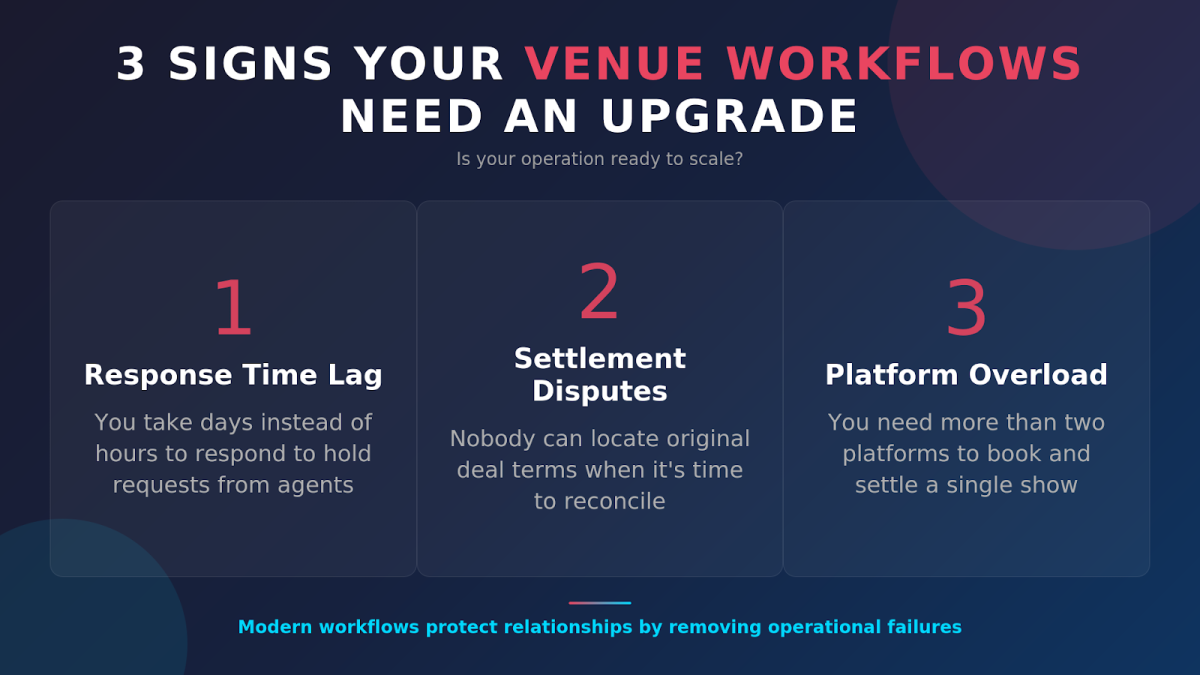
The consequences are predictable and expensive. Double-bookings happen when calendar updates lag. Settlement disputes arise when nobody can locate the original deal terms. Agents lose patience with venues that take days to confirm availability. Shows go to competitors who respond faster.
What Are the Core Components of Effective Venue Management Workflows?
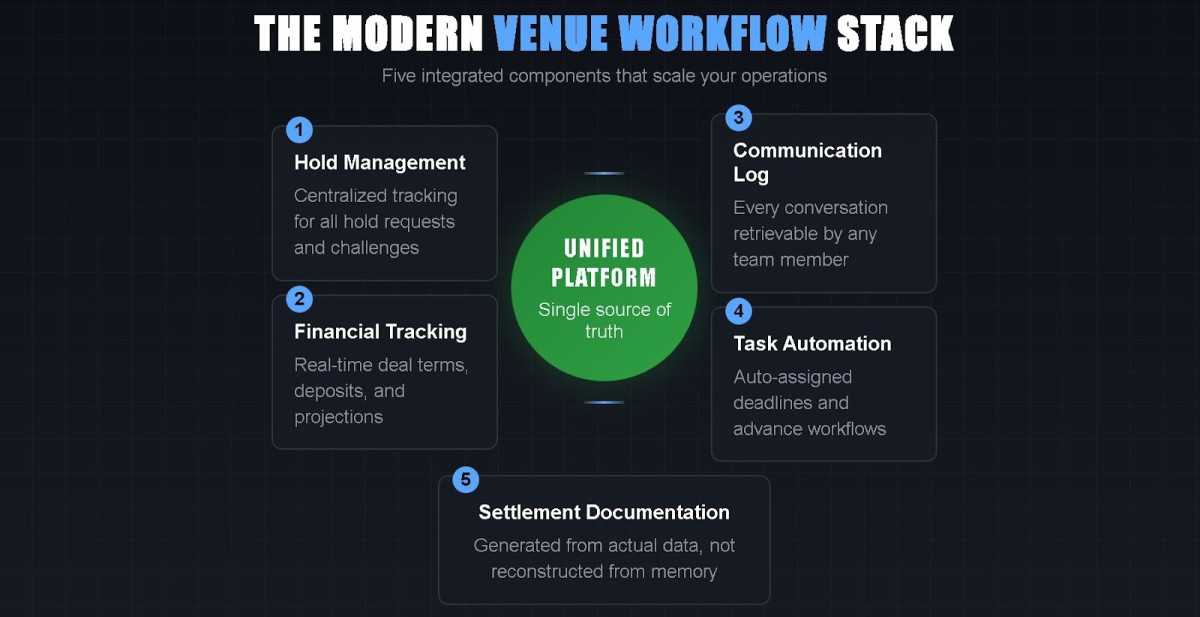
Modernizing venue event operations is about building workflows that eliminate friction at every stage of the booking cycle. The venues and promoters scaling successfully have systematized these core functions:
Centralized Hold and Availability Management
Every show begins with a hold request. Effective workflows capture these in a single system that all stakeholders can access. When an agent challenges a hold, the response happens within hours rather than days. When a hold converts to a confirm, every downstream task triggers automatically.
Integrated Financial Tracking
Deal terms, deposits, ticket counts, and settlement figures should live in one place. When ticket sales update, projections update. When costs get added, margins recalculate. This visibility prevents the end-of-show scramble to reconcile what was promised versus what happened.
Standardized Communication Logging
Every email, call, and text about a show should be retrievable by anyone on the team. This sounds obvious, but most operations fail here. When the booker who made the deal is unavailable, someone else should be able to step in without starting from scratch.
Automated Task and Deadline Management
Advancing a show involves dozens of tasks with hard deadlines. Hospitality riders, marketing assets, production schedules, day-of-show logistics. Workflows that automatically assign and track these tasks prevent the 48-hour panic that happens when something falls through the cracks.
Settlement Documentation
The final settlement should be generated from actual data, not reconstructed from memory and scattered notes. This visibility protects both the venue and the promoter, creating a clean record that withstands scrutiny from artists, agents, and accountants.
How Do Promoter Booking Operations Interface with Venues?
The workflow conversation can't stop at venue walls. Promoters face their own scaling challenges, and the friction between promoter systems and venue systems creates problems for everyone.
A regional promoter working with 15 venues might encounter 15 different processes for submitting holds, receiving confirmations, and settling shows. Some venues want everything in email. Others use shared calendars. A few have adopted modern platforms. This inconsistency forces promoters to maintain multiple workflows, increasing error rates and slowing response times.
The solution is to ensure that live event management tools can share critical information within promoter booking operations. When a promoter's offer acceptance automatically populates the venue's calendar and triggers the standard advance timeline, both parties save hours per show.
Co-promotion adds more complexity. When two promoters split a show, the workflow needs to track shared costs, divided revenue streams, and the final reconciliation. Venues caught in the middle of unclear co-pro arrangements often end up mediating disputes that proper documentation would have prevented.
What Technology Integration Do Modern Venues Need?
Not every venue needs enterprise-level software. But every venue scaling beyond a handful of monthly shows needs systems that talk to each other. Currently, 79% of event professionals are leveraging an Event Management System to streamline planning. The minimum viable tech stack for modern venue management workflows includes:
Ticketing Integration
Your booking system should automatically pull ticket sales. Manual entry of ticket counts invites errors and delays settlement. The venues running the cleanest operations have real-time visibility into sales without logging into separate platforms.
Calendar Synchronization
Whatever system manages your holds and confirms needs to sync with whatever calendar your team actually uses. A beautiful booking platform that nobody checks is worse than a shared Google Calendar that everyone lives in.
Document Generation
Offers, contracts, and settlements should generate from your existing data. Re-typing deal terms into a contract template is wasted time and a source of errors. The goal is a single source of truth that flows through every document.
Mobile Access
Live music doesn't happen at a desk. Venue managers and promoters need to check availability, respond to holds, and review financials from their phones. Any system that requires a laptop for basic functions will get abandoned during busy periods.
FAQs About Venue Management Workflows
What is the difference between venue management software and general event management platforms? General event management platforms handle corporate conferences, weddings, and trade shows with generic features. Venue management software built for live music understands industry-specific workflows like hold challenges, percentage deals, co-promotion splits, and artist settlements.
How long does it take to implement new venue management workflows? Most venues can transition core booking and calendar functions within weeks. Full implementation, including financial integration, team training, and historical data migration, typically takes 60 to 90 days. The key is starting with high-impact workflows like hold management before expanding to settlements and reporting.
Can smaller venues benefit from workflow automation? Absolutely. Venues booking 50+ shows annually see immediate returns from automated hold tracking and integrated calendars. The time saved on admin translates directly into capacity for booking more shows and building stronger agent relationships.
How Can Venues Build Workflows That Scale?
The venues and promoters winning at scale share a common approach. They've stopped treating each show as a unique project and started treating shows as instances of a repeatable process. The creativity goes into the event itself. The operations run on systems.
Using live event management tools doesn't mean removing human judgment. It means reserving human judgment for decisions that actually require it. Whether to book an emerging artist is a judgment call. Whether the deposit was received is a data point. Successful workflows automate the data points and protect time for the judgment calls.
The music industry has always been relationship-driven, and that won't change. But relationships suffer when basic operational failures create friction. Agents remember which venues lose contracts. Promoters remember which venues dispute clear deal terms. Building reliable venue management workflows protects relationships by removing the operational failures that damage them.
For venues and promoters ready to systematize their operations, Prism offers purpose-built solutions designed by live music industry veterans who understand the unique demands of booking, advancing, and settling shows at scale.